



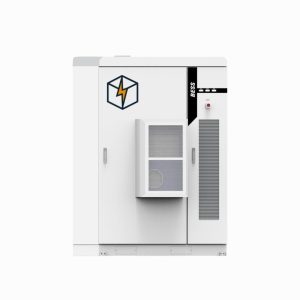

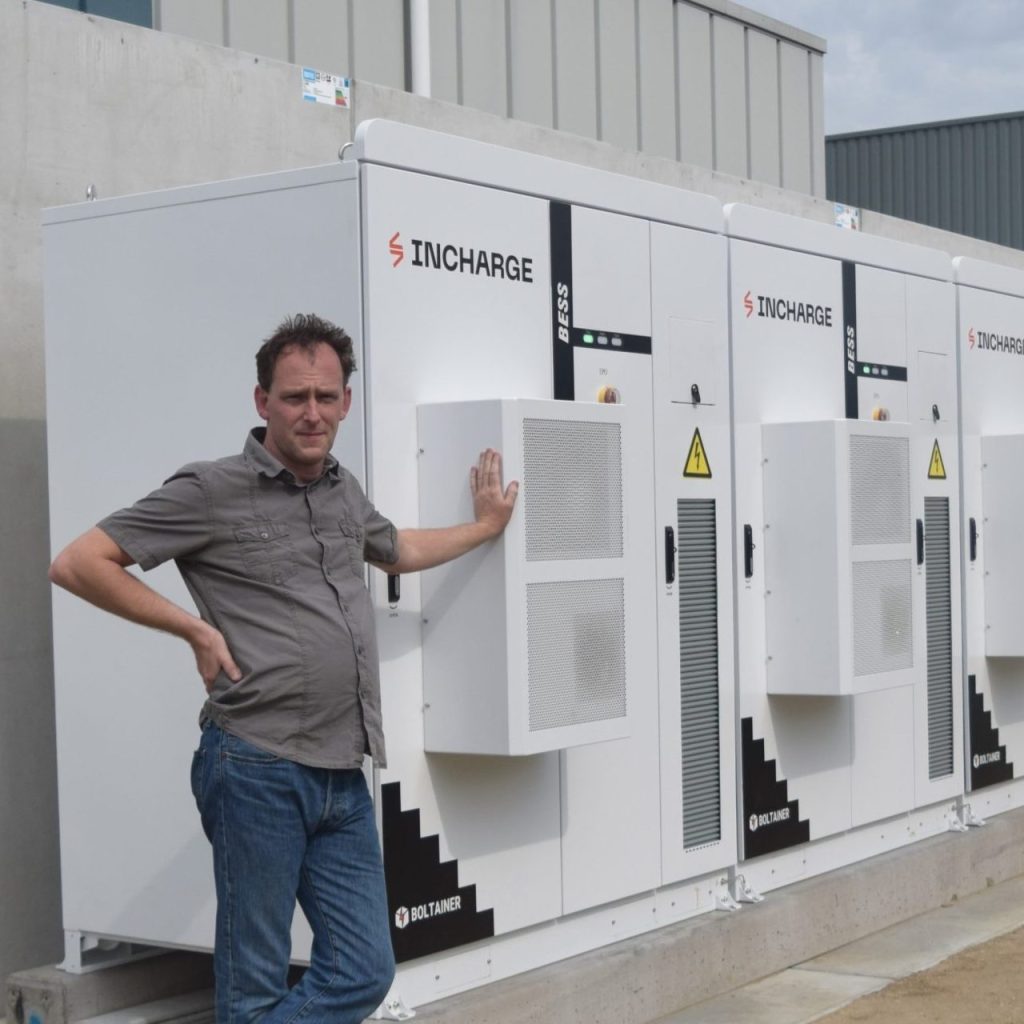
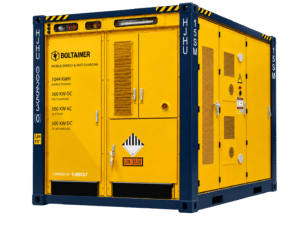
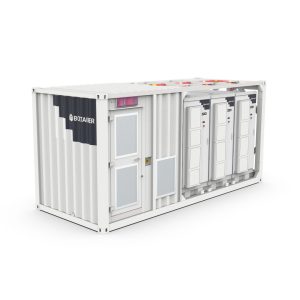




The five components of a complete BESS
| Component | Abbreviation | Function | Key feature |
|---|---|---|---|
| Battery cells | — | Storing and releasing energy | LFP for maximum safety and service life |
| Battery management system | BMS | Monitoring, protecting, and balancing cells | Prevents overcharging and undercharging |
| Power converter | PCS | Converts DC (battery) to AC (mains) | Determines the maximum charging/discharging capacity |
| Energy Management System | EMS | Manages the entire system based on data and objectives | The brain that maximizes performance |
| Cooling and safety systems | HVAC + FDS | Temperature control, fire detection, and suppression | Essential for safety and longevity |
How do the components work together?
In a functioning BESS, all components work together in a continuous cycle. Here’s what a typical day looks like for an industrial BESS system:
At night: charging using cheap electricity
The EMS detects that the energy price on the day-ahead market is low (high wind generation, low demand). It instructs the PCS to charge the battery. The PCS converts alternating current from the grid to direct current for the battery modules. The BMS continuously monitors cell voltage, current, and temperature to prevent overloading. The cooling system maintains the temperature within the optimal range of 20–35°C.
During the day: peak shaving during periods of high operational load
The EMS detects that the system's power consumption is about to exceed the set peak limit. The PCS discharges the battery at exactly the power level needed to offset the peak. The BMS monitors the State of Charge (SoC) and signals in a timely manner when the discharge should stop.
Ongoing: adapting to changing circumstances
The EMS continuously recalculates the optimal strategy based on new data: current energy prices, weather forecasts, planned production, and signals from the grid operator. The strategy is adjusted every few minutes.
The three BESS categories for business applications
Category 1: Behind-the-Meter (BtM)
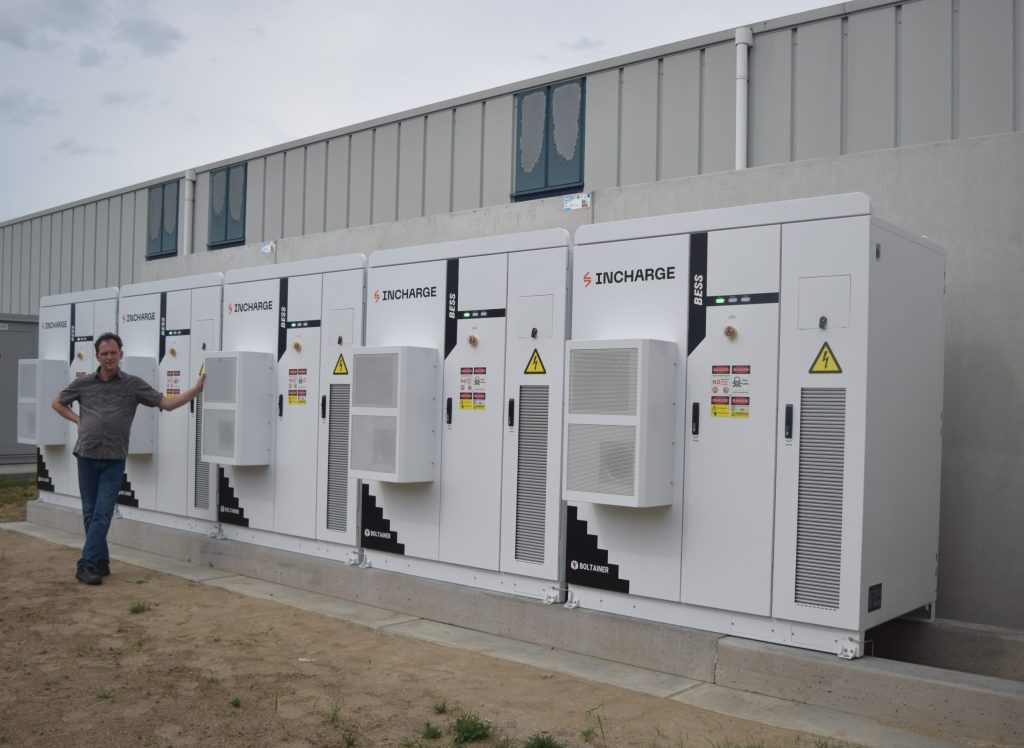
The BESS is installed behind the company's electricity meter. None of the electricity that the BESS stores or supplies passes through the meter. Applications: peak shaving, self-consumption of solar power, emergency power. This is the most relevant category for most Boltainer customers.
Category 2: Front-of-the-Meter (FoM)
The BESS is directly connected to the public grid. Applications include trading on energy markets, frequency regulation, and grid support services. These are typically large-scale systems operated by energy companies and grid operators.
Category 3: Hybrid (BtM + FoM)
The BESS is primarily installed behind the meter but also has the capability to participate in balancing markets. This is the most attractive model for larger business customers who want to both optimize their own energy costs and generate additional revenue.
Battery chemistry: why LFP has become the standard
| Property | LFP | NMC | LCO (smartphones) |
|---|---|---|---|
| Thermal stability | Excellent | Fair | Bad |
| Service life (cycles at 80% SoH) | 3,000–6,000 | 1,000–2,000 | 500–1,000 |
| Energy density (Wh/kg) | 150–200 | 200–300 | 150–200 |
| Cost (€/kWh of capacity) | Low | Medium | High |
| Risk of thermal runaway | Very low | Fair | High |
| Suitability for stationary storage | Ideal | Acceptable | Not suitable |
What does Boltainer's containerized approach entail?
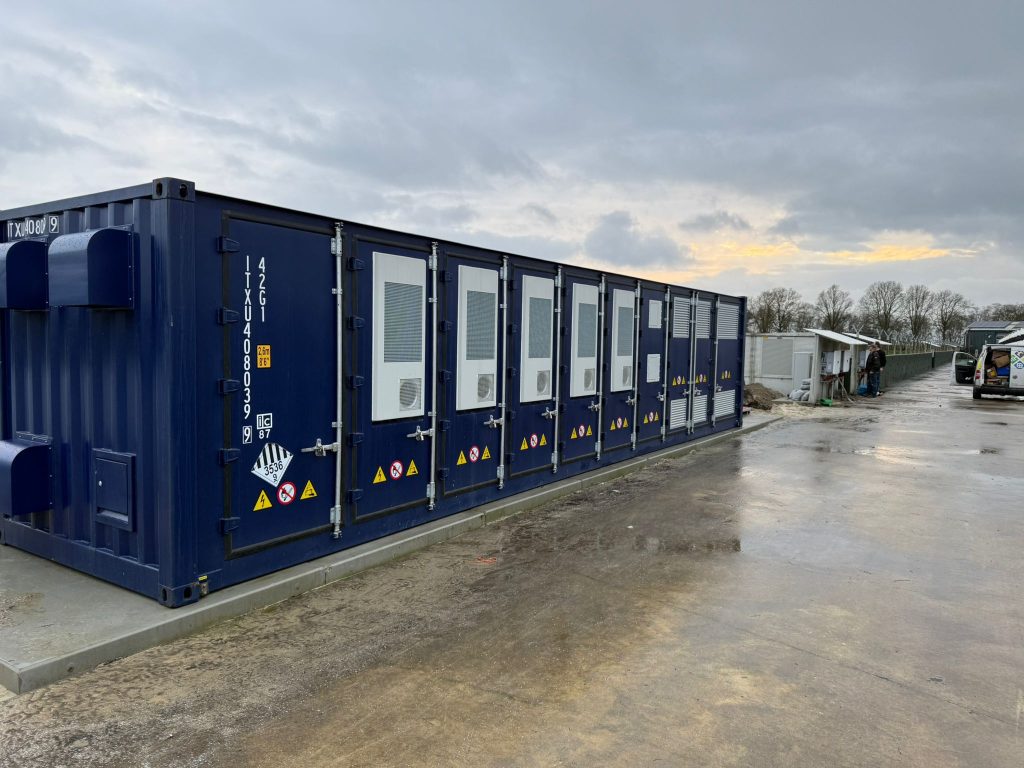
All components of the BESS are integrated and tested by Boltainer in an industrial container. This offers significant advantages over an on-site installation:
- Factory testing: The entire system is tested before it leaves the factory. This reduces the risk of installation issues on-site.
- Shorter deployment time: two to four weeks versus three to six months for a traditional installation.
- Lower installation costs: less on-site civil work, fewer hours spent on engineering and wiring.
- Relocatable: The container can be moved if business conditions change.
- Expandable: Additional containers can be easily added as your needs grow.
Frequently Asked Questions About BESS
What is the difference between a BESS and a UPS?
A UPS (Uninterruptible Power Supply) is designed to provide short-term emergency power (minutes) during a power outage. A BESS is designed for daily charge-discharge cycles lasting several hours and for multiple simultaneous applications such as peak shaving, arbitrage, and self-consumption. A BESS can also function as a UPS if configured to do so.
How long does a BESS last?
An LFP-based BESS has an expected service life of 15–20 years. After 10 years, 75–80% of the original capacity remains, as guaranteed by our 10-year cell warranty. The electrical components (PCS, BMS, EMS) have an expected service life of 15–20 years with proper maintenance.
What standards must a BESS meet?
For commercial installations in the Netherlands, the main standards are: IEC 62933 (stationary energy storage), IEC 62619 (safety of lithium cells), NEN 1010 (electrical installations), CE marking for the European market, and the requirements of the local environmental permit. All Boltainer systems are certified in accordance with these standards.
Can a BESS still function during a power outage?
By default, no—a behind-the-meter BESS is grid-connected and shuts down during a power outage (to prevent the grid from becoming hazardous to technicians working on it). With a special off-grid configuration, a BESS can also continue to operate during a power outage. Be sure to ask specifically about this if emergency power functionality is a requirement.
How much space does a BESS require?
A 400 kWh Boltainer container has a footprint of approximately 6 × 2.5 meters (equivalent to one 20-foot container). Larger systems require multiple containers placed side by side. A minimum of 1 meter of clear space is required around each container for cooling, access, and fire safety.