



How does a flexible connection differ from a fixed connection?
| Feature | Fixed connection | Flexible connection |
|---|---|---|
| Guaranteed connected load | Always fully available | Maximum value, but temporarily reducible |
| Waiting time during congestion | Long (3–7 years) | Shorter (6 months – 2 years) |
| Connection fee | Default | Sometimes a lower reimbursement as compensation |
| Operational risk | None (warranty) | Yes — but manageable on battery power |
| Suitable for critical processes without a backup | Yes | No |
| Suitable for critical processes with battery backup | Yes | Yes |
How often is a flexible connection actually restricted?
The frequency of restrictions varies by region and season. Based on data from Dutch grid operators:
| Traffic congestion intensity in the region | Estimated annual restriction events | Average duration per disability |
|---|---|---|
| Light traffic | 5–20 times a year | 1–3 hours |
| Moderate congestion | 20–60 times a year | 2–6 hours |
| Heavy traffic | 60–150 times a year | 2–8 hours |
In the worst-case scenario, there could be up to 150 load-shedding events per year, each lasting an average of 6 hours. That amounts to 900 hours per year during which connected power capacity may be reduced—less than 10% of the total annual hours.
How large does the battery need to be to serve as a backup for a flexible connection?
The required battery capacity depends on:
- The maximum power reduction that the grid operator can impose (kW)
- The maximum duration of a restriction (hours)
- The critical power consumption of your business processes (kW)
Formula: Battery capacity (kWh) = Min(power reduction, critical consumption) × maximum restriction duration (hours)
Example: The grid operator can reduce your connected load by 300 kW for up to 4 hours. Your critical processes consume 200 kW. The minimum battery capacity for full continuity is 200 × 4 = 800 kWh. In practice, 400–600 kWh is often sufficient if you can temporarily pause non-critical processes.
The business case for a flexible connection + battery
A flexible connection combined with a battery offers two mutually reinforcing advantages:
- Faster time to market: instead of waiting five years for a fixed connection, you can be up and running within one to two years. The revenue you generate sooner as a result has enormous economic value.
- Battery benefits from day one: the battery you install as a backup for your flexible connection also handles peak shaving, self-consumption, and, if necessary, congestion management. You’re investing in a multifunctional system, not just an expensive backup.
Frequently Asked Questions About the Flexible Connection
What exactly is a flexible connection?
A flexible or interruptible connection is a grid connection that allows the grid operator to temporarily reduce the available power in the event of an overload. In exchange, you’ll be connected more quickly than with a standard fixed connection, which involves a waiting period.
What are the terms and conditions of a flexible connection?
The exact terms and conditions vary by grid operator and project, but typically include: maximum power reduction (kW), maximum duration per restriction (hours), maximum annual restriction hours, advance notice period (hours/minutes), and any compensation payments.
Can I switch from a flexible plan to a fixed-line connection?
In most cases, yes, but that means you’ll have to wait in line again for a regular connection. So the flexible connection gives you a temporary but valuable head start.
How quickly does a battery system respond to a curtailment signal?
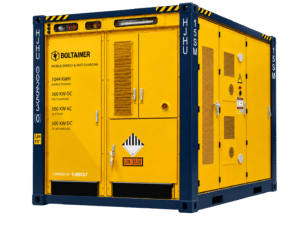
The Boltainer EMS responds to a digital activation signal within seconds. If the battery is sufficiently charged, it immediately takes over production without any noticeable interruption to business operations.